BC Greens end CARGA accord 2026

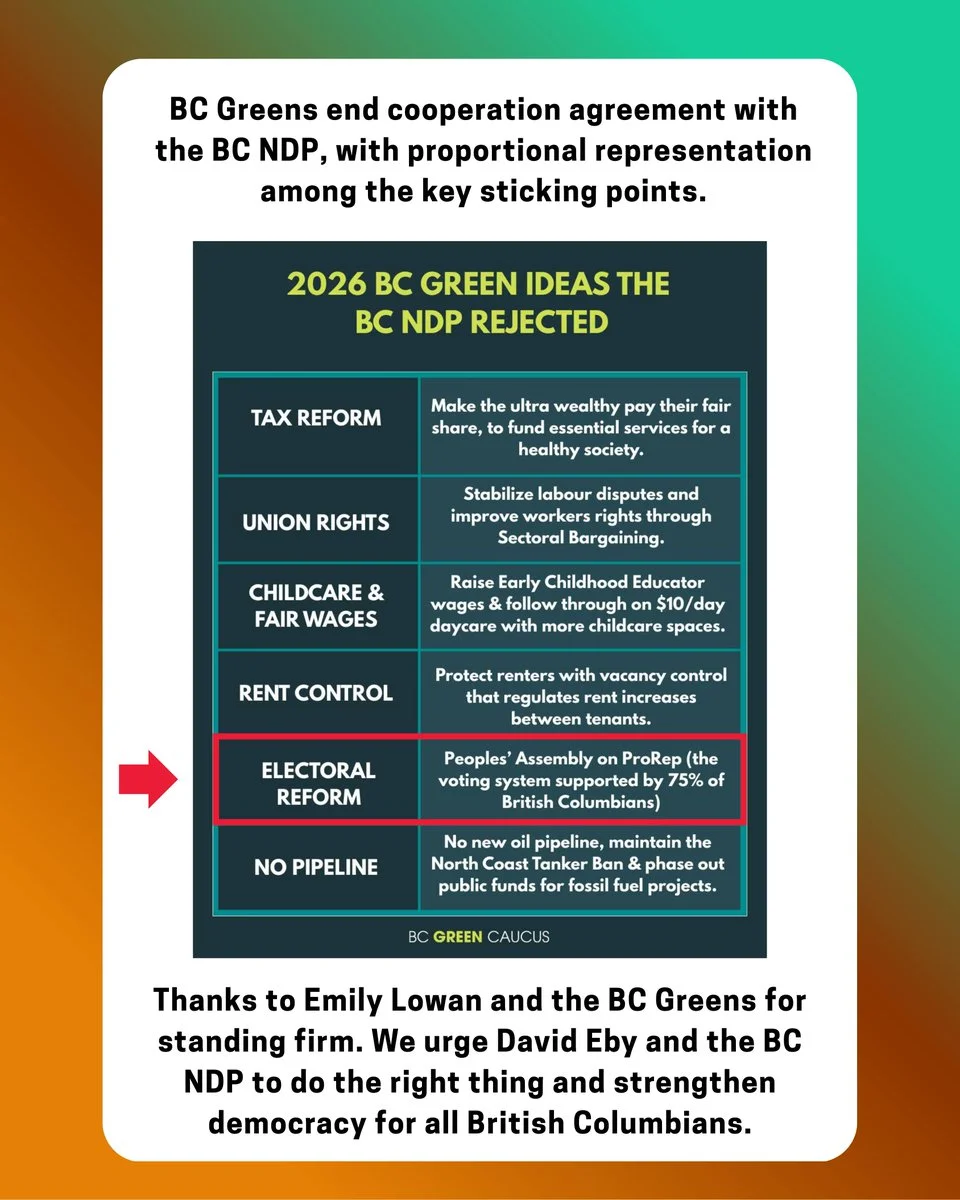
The British Columbia Green Party has announced it will not renew the Cooperation and Responsible Government Accord, or CARGA, with the BC NDP. The decision, disclosed on February 9, 2026, comes as the province sits with a one-seat NDP majority and a Green caucus that has deliberately signaled a shift away from shared governance measures that were designed to stabilize the legislature. The move marks a pivotal moment for BC politics and could influence the timing and outcome of any potential future votes or elections. The Green leadership framed the decision as a response to stalled or undelivered commitments within the agreement, and it raises questions about how the province will manage critical policy initiatives on health care, housing, transit, climate, and democratic reform moving forward. This moment matters for voters, operators of public services, and market-watchers tracking governance risk in a province that has long balanced stability with ambitious reform agendas. BC Greens end CARGA accord 2026 is the focal point of today’s coverage, reflecting a data-driven assessment of what the pact delivered versus what it promised. (bcgreens.ca)
With the BC NDP maintaining a majority in the legislature, the immediate political impact of the decision is clear: the government’s ability to rely on a formal confidence mechanism through CARGA is ending, and joint votes or policy initiatives will now proceed on a bill-by-bill basis, rather than under a standing framework of cross-party commitments. The Green leadership noted that the majority remains with the NDP; however, the absence of CARGA’s governance framework means fewer automatic alignments on key legislation, potentially altering the pace and direction of policy implementation. In a news brief delivered shortly after the announcement, BC Green Leader Emily Lowan underscored the procedural shift while emphasizing continued engagement with citizens on shared priorities. The decision to step away from CARGA follows months of public debate about the pact’s effectiveness and the degree to which it advanced core reforms. (globalnews.ca)
The timing of this development matters for British Columbians and for markets that monitor provincial governance stability. CARGA, signed in December 2024 and finalized in March 2025, was designed to align the two parties on a broad set of priorities, including health care, housing and homelessness, transit, climate and environment, social and economic justice, taxation, and electoral reform. The arrangement aimed to deliver measurable progress while providing a mechanism for accountability through quarterly reporting. As of early 2026, observers are weighing what the absence of CARGA means for the provincial government’s ability to enact large-scale plans and to respond to urgent issues facing families, workers, and communities across BC. The Greens’ decision to end CARGA is being read by many as a recalibration of BC’s governing dynamics rather than a necessarily adversarial move, though it certainly introduces new political risk depending on how the government proceeds without the pact’s formal confidence framework. (bcgreens.ca)
Section 1: What Happened
Background: The birth and scope of CARGA
- December 2024: The Cooperation and Responsible Governance Accord began as a framework for cross-party collaboration between the BC NDP government and the BC Green caucus. The intent was to stabilize governance while pursuing a shared policy agenda on critical priorities for British Columbians.
- March 12, 2025: After negotiations and a formal in-principle agreement, the two parties finalized the terms of CARGA. The final terms were publicly announced and signaled a commitment to joint action on health care, housing, transit, climate action, and other social and economic priorities. The agreement also included provisions for quarterly reporting to expose progress and challenges to voters. These steps were reported by multiple outlets and reflected in the official party communications. (bcgreens.ca)
The announcement and what changed on February 9, 2026
- February 9, 2026: BC Green Party Leader Emily Lowan announced that the BC Greens will not renew CARGA with the BC NDP. The leader stated that the governing party had not delivered on a substantial portion of the commitments within the pact and that renewal would not be pursued. The press release framed the move as a response to what the Greens described as stalled or undelivered commitments, signaling a shift toward voting on a bill-by-bill basis rather than operating under a standing cross-party agreement. The Greens emphasized that, with the NDP holding a majority, call options on elections rest with the Premier, not the Greens. This development was broadly covered by national and regional outlets, and it anchored a new phase in BC’s political governance. (bcgreens.ca)
Details of the termination and immediate effects
- The BC Greens declared that they would not renew CARGA as of its scheduled expiry in March 2026. The timing means the pact’s formal confidence mechanism will not continue beyond its prior term, and the Greens indicated that they would assess and vote on government bills on a case-by-case basis going forward. The move was described by party officials as a principled realignment—one that prioritizes accountability for deliverables while recognizing the current political composition. Reports and statements from multiple outlets highlighted that two Green MLAs, along with the Green leadership, will now determine their votes on legislation individually, rather than as a unified governing caucus under CARGA. (globalnews.ca)
Timeline snapshot: A data-driven view of the arc
- December 2024: CARGA introduced as a political instrument intended to bridge policy gaps and stabilize governance with a one-seat-leaning majority. This initial step set the stage for a formal governance framework between the NDP and Green caucuses. (globalnews.ca)
- March 12, 2025: Final terms of CARGA signed and publicly announced, consolidating joint priorities and reporting requirements. The public record emphasizes collaboration on health care, transit, housing, climate, and democratic reform. (bcgreens.ca)
- May–June 2025: The Green and NDP caucuses released quarterly CARGA progress reports, illustrating ongoing efforts to track deliverables and maintain transparency with British Columbians. While progress varied by policy area, the process itself became a visible governance mechanism and a communications tool for both parties. (bcgreens.ca)
- February 9, 2026: BC Greens announce they will not renew CARGA, citing stalled or undelivered commitments. This marks a formal end to the agreement’s renewal. The announcement is consistent with coverage across multiple outlets and reflects a strategic recalibration by the Green caucus. (bcgreens.ca)
- March 2026: With the pact not renewed, CARGA’s status shifts to a sunset scenario, potentially affecting the government’s legislative agenda and confidence dynamics during a period when the NDP holds a minority-leaning majority on paper. Observers will watch for whether any new parallel arrangements emerge or if the parties revert to standard partisan dynamics. (globalnews.ca)
Section 2: Why It Matters
Governance stability and the one-seat majority
- The BC NDP entered a period of governance with a one-seat majority, a dynamic that historically heightens the importance of any formal agreement or confidence mechanism. The end of CARGA removes a codified cross-party framework meant to ensure smoother passage of key policies. Analysts note that while the NDP retains the ability to govern, the absence of a shared governing blueprint could introduce more negotiation friction for controversial bills or budget measures, as Green votes are no longer automatically aligned with the government on a broad set of deliverables. This shift is central to assessments of BC’s political stability and legislative agility as of early 2026. (globalnews.ca)
Policy commitments and real-world implications
- CARGA’s intended policy scope touched health care (including mental health expansion and service access), housing and homelessness strategies, transit expansion (including regional corridors), climate initiatives, and democratic/electoral reform. The Green leadership has argued that a substantial portion of those commitments remained unfulfilled or were deprioritized, which is a core justification for not renewing the pact. For residents and workers, the practical implications hinge on whether those deliverables will be pursued via standalone initiatives or slower/modified timelines under a return to standard election-cycle politics. The pandemic-era context and ongoing housing affordability concerns amplify the stakes for timely progress on health care access, transit improvements, and climate resilience projects. (bcgreens.ca)
Impacts on communities, businesses, and markets
- From a governance perspective, the end of CARGA could influence the speed at which large-scale projects materialize. For communities awaiting expansions of community health facilities, transit projects along the Sea-to-Sky corridor, or debt-financed housing initiatives, the absence of a formal cross-party timetable may reintroduce policy uncertainty. Markets and economic stakeholders typically assess governance stability when evaluating long-range capital investments and public-private partnerships in infrastructure; the eventual clarity on how BC approaches budget planning and program rollouts post-CARGA will be watched by investors and local leaders. The transition could also shape public sentiment about government responsiveness and credibility, factors that influence consumer confidence and local business investment. (vancouver.citynews.ca)
Context: how CARGA fit into BC’s wider political landscape
- The CARGA arrangement emerged after the Green party’s ascent as a formal partner to the NDP government, rather than as a traditional coalition. The signatures and subsequent quarterly reporting offered a level of public accountability and policy alignment across major areas. The end of the pact occurs in a broader context of ongoing policy debates around health equity, climate action, housing affordability, and fiscal stewardship. While the final terms of CARGA were celebrated as a milestone in cross-partisan governance, critics argued that the agreement’s deliverables were unevenly achieved, and supporters contended that the arrangement produced measurable gains in areas aligned with both parties’ priorities. The public record includes statements and reporting that illustrate both perspectives, underscoring the importance of sustained, transparent governance even as a new phase unfolds. (globalnews.ca)
Section 3: What’s Next
Next steps for the parties and the province
- For the BC Greens: The party has signaled a return to more traditional, party-led governance where policy wins are pursued through the legislative process without a formal cross-party framework. The emphasis will likely be on maintaining credibility with supporters and voters while advancing a policy agenda that aligns with their platform. The Green caucus will need to navigate opportunities to influence bills on a case-by-case basis, potentially seeking strategic alignments with other political actors when beneficial for constituents. Public communications will continue to stress science-based policy, regional development, and transparency as core values, alongside a new emphasis on accountability for delivered commitments. (bcgreens.ca)
- For the BC NDP: The dissolution of CARGA places renewed responsibility on the government to manage legislative priorities without the formal backbone of the accord. The Premier and senior ministers may pursue a re-prioritized agenda with a focus on delivering visible results across health care, housing, transit, climate initiatives, and social programs. The absence of a formal cross-party framework could either slow progress due to tighter party-line dynamics or, in contrast, sharpen the government’s emphasis on faster action through targeted policy packages and budgetary measures. Observers will be watching for how the government communicates with the public about progress and setbacks in key files. (globalnews.ca)
Timeline and key milestones to watch
- March 2026: The formal expiry of CARGA could mark a transition point for legislative scheduling and policy execution. While the NDP maintains governance authority, the absence of a renewal process will require new explicit strategies for managing votes and ensuring public buy-in for major initiatives. This period will be critical for assessing whether any new governance arrangements surface or if the parties return to standard partisan procedures. (vancouver.citynews.ca)
- Legislative session cadence: Expect a recalibration of committee work, budget cycles, and key policy deliverables in the months following March 2026 as both parties recalibrate their positions and messaging in a post-CARGA environment. The pace and scope of policy announcements could hinge on the political calendar, the strength of constituency pressures, and the province’s fiscal position. (globalnews.ca)
What to watch for in policy areas that CARGA prioritized
- Health care and mental health: The pact highlighted steps to expand access to psychologists, reduce wait times, and broaden community health services. In a post-CARGA landscape, observers will monitor whether the government continues momentum on mental health investments and whether new funding commitments are announced in the provincial budget or as standalone measures. (bcgreens.ca)
- Transit and regional development: The Sea-to-Sky corridor and related transit initiatives were central to CARGA’s agenda. In the absence of renewal, the province’s public transit plans may shift toward project-by-project approvals or new partnerships with municipalities and the private sector. Monitoring announcements from the Ministry of Transportation and the Green caucus will be important for understanding the trajectory of these big-ticket projects. (bcgreens.ca)
- Climate action and environmental policy: CARGA framed climate and environmental policy as a shared priority. The post-CARGA period will reveal how aggressively the government pursues climate targets, how it coordinates with First Nations and other stakeholders, and how market dynamics (such as carbon pricing or industrial regulation) evolve without the formal cross-party framework. The BC Greens’ ongoing statements and policy positions can serve as a signal of emphasis areas in climate governance. (bcgreencaucus.ca)
Closing: Staying informed in a evolving political landscape
- The BC Greens’ decision to end CARGA is a landmark development for British Columbia’s political landscape, reflecting a shift in how governance and policy collaboration are approached in a one-seat majority environment. It also signals potential changes in how voters evaluate government performance, the pace of policy delivery, and the balance between party leadership and cross-party cooperation on complex, cross-cutting issues. BC Times will continue to monitor and report on the consequences of this decision, tracking how the absence of a formal pact affects health care expansion, housing affordability, transit improvements, climate action, and electoral reform discussions in the months ahead. For readers seeking ongoing coverage, we will provide updates as the province moves through the March 2026 expiry and beyond, with data-driven analysis and balanced perspectives on what the end of CARGA means for British Columbians. (bcgreens.ca)