News
BC Hydro Campbell River Fast-charge Hub Opens
Explore the data-driven analysis of BC Hydro's Campbell River fast-charge hub and its significant impact on EV charging across Vancouver Island.
By Joanna Flett · August 23, 2026 · 10 min read
 By Joanna Flett · August 23, 2026 · 10 min read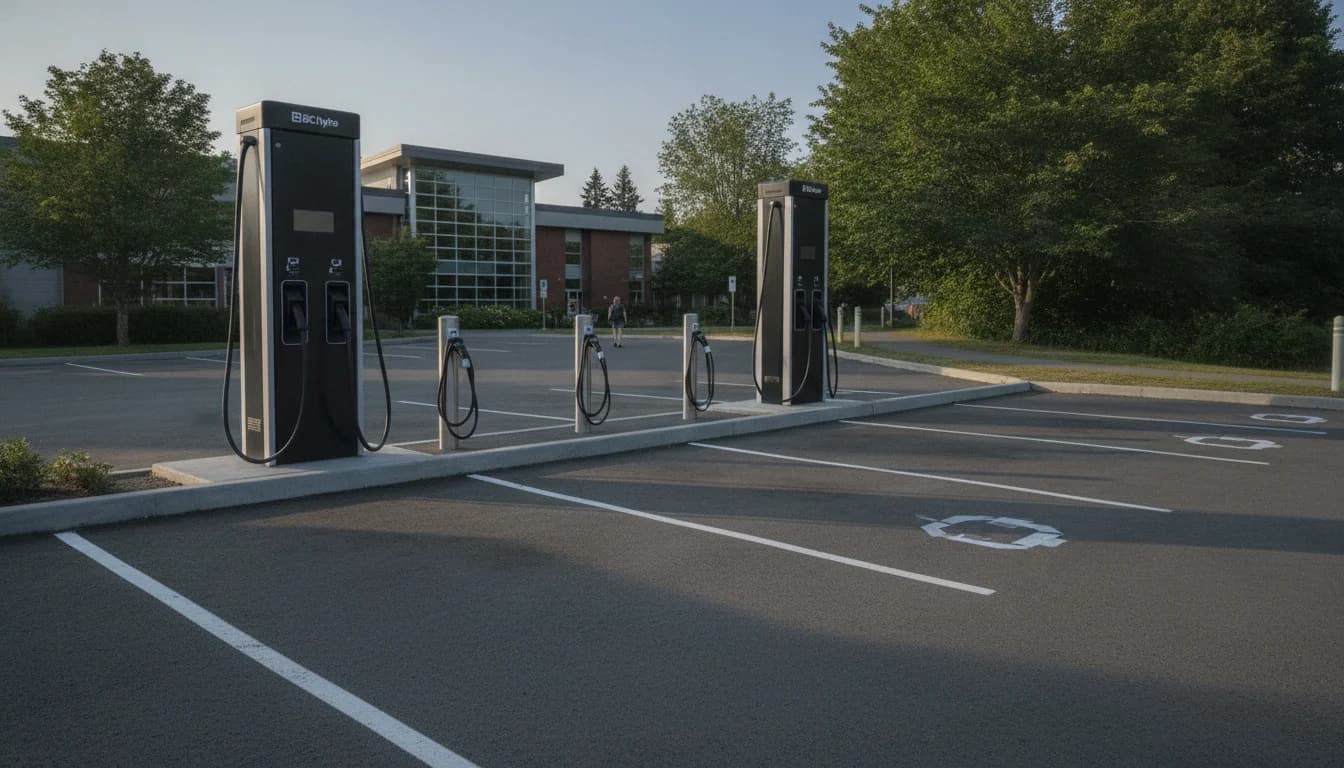
BC Hydro opened a new EV fast-charge hub at the Strathcona Gardens Recreation Complex in Campbell River on August 19, 2026, featuring two 180-kilowatt fast chargers and four Level 2 chargers. This milestone marks a concrete step in BC Hydro’s broader strategy to expand high‑power charging options for residents and travelers along Vancouver Island, aiming to reduce charging wait times and increase reliability for electric vehicles. The announcement came via BC Hydro’s official news release, which also notes the site’s location at 225 South Dogwood Street and its partnership with the Strathcona Regional District. The hub is designed to serve up to eight vehicles simultaneously across its high‑power units and mixed charging modalities, signaling a deliberate move toward hub-based charging infrastructure on regional corridors. This opening aligns with the province-wide push to scale public charging to 3,500 ports by 2035, backed by a multi‑hundred‑million dollar investment to deploy larger hubs, faster technology, and enhanced customer features. (bchydro.com)
What Happened
Site Details and Capacity The Campbell River fast-charge hub sits in the parking lot of the Strathcona Gardens Recreation Complex, a location selected to maximize accessibility for locals and travelers alike. According to BC Hydro’s release, the site provides two 180‑kW fast chargers and four Level 2 charging ports, arranged to optimize utilization through power‑sharing technology. Each 180‑kW unit can serve two vehicles at once by splitting output, meaning the two units together can power up to four EVs at peak simultaneously. In practical terms, this design reduces individual charger wait times and improves throughput for short‑duration trips common along Vancouver Island corridors. The address and site details are explicitly listed in the BC Hydro filing, underscoring the hub’s community-focused positioning. The site’s power-sharing approach allows for flexible load management, which is particularly valuable during peak travel periods when demand on the regional grid can fluctuate. (bchydro.com)
Technology and Connectors The new Campbell River hub is equipped with a comprehensive mix of connector types to accommodate a wide range of electric vehicles. The configuration includes CCS, NACS, CHAdeMO, and J1772 connectors, enabling both early‑and late‑generation EVs to charge without compatibility concerns. The inclusion of multiple connector standards reflects BC Hydro’s emphasis on universal accessibility and user convenience, aligning with the province’s broader plan to ensure public charging remains usable for a diverse EV fleet. The charging site is described as “state‑of‑the‑art” in BC Hydro’s communications, highlighting both the high wattage of the fast chargers and the versatility of the port options. The press release also notes that the site provides four Level 2 chargers to support slower charging needs or to serve additional vehicles when the fast chargers are in heavy use. The combination of 180‑kW fast charging and Level 2 options positions Campbell River as a functional hub rather than a standalone single‑port charger. (bchydro.com)
Partnerships and Official Statements The Campbell River hub represents a collaborative effort, developed in partnership with the Strathcona Regional District. Local leadership emphasized the value of such partnerships in delivering durable infrastructure that serves both residents and visitors. The Board Chair of the Strathcona Regional District described the project as a strong example of what can be achieved through collaboration with organizations like BC Hydro, underscoring the hub’s potential to reinforce regional economic activity by supporting cleaner transportation options. On the provincial side, BC Hydro President and CEO Charlotte Mitha framed the project within a broader investment strategy to expand public charging network capacity, reflecting the government’s goals to support EV adoption and grid reliability. The public statements from regional and provincial leaders together frame the Campbell River site as part of a larger continuum of infrastructure expansion rather than a one-off installation. (bchydro.com)
Broader Network Context and Timeline BC Hydro’s Campbell River hub is part of a broader, ambitious expansion of the province’s public EV charging network. The company’s July 2026 update outlined plans to expand to 3,500 charging ports by 2035, a multi‑year, $700‑million initiative focused on building larger charging hubs and deploying faster charging technology across BC. The Campbell River site, with eight ports total and high‑power capability, exemplifies the hub model that BC Hydro has prioritized for reducing wait times and enabling longer trips along major routes. This approach is reinforced by BC Hydro’s ongoing strategy to place more hubs in urban centers and along key corridors, a logic that has shaped the company’s site selection and technology choices across the system. BC Hydro’s public charging network is also highlighted as the province’s most expansive, with the company owning the majority of Electric Highway locations and continuing to expand access for a wide range of EVs. (bchydro.com)
Operational and Market Implications The Campbell River fast-charge hub adds to a rapidly evolving market for public charging across British Columbia. BC Hydro reports that its charging network has grown fivefold in the past two years, driven by a combination of higher-power hardware, improved customer features, and expanded site coverage. The press release notes that there are now more than 40 hubs open across the province, each offering a range of ports to accommodate both rapid and longer-duration charging, including medium‑duty electric vehicles at some locations. The release also references ongoing investments and upgrades that signal a multi‑year ramp to the 3,500 port target, suggesting a sustained upward trajectory for both supply and utilization. Observers often frame these developments as part of a broader move toward corridor-based, hub-centric public charging that reduces fragmentation and improves reliability for EV drivers. The Campbell River hub is a practical demonstration of how these concepts translate into a real‑world location with multiple charging modalities and a clearly defined purpose within the network. (bchydro.com)
Timeline and Next Steps BC Hydro’s press release situates Campbell River as a mid‑2016s–to–2030s era milestone in a broader program. The company has already opened other fast-charge sites, including a hub in the Southern Gulf Islands announced for August 17, 2026, and continues to expand along major travel corridors to minimize wait times and improve reliability. The timeline referenced in the release indicates a rolling series of hub openings throughout 2026 and beyond, with a stated goal to accelerate the pace of deployment to reach the 3,500 port target by 2035. The plan includes adding more high‑power charging units, deploying 400‑kW and 350‑kW chargers at select sites, and maintaining a dense network so that drivers can plan longer trips with confidence. The strategy also mentions a public‑facing app and standardized customer features designed to improve user experience across hubs, which is consistent with BC Hydro’s emphasis on customer-centric, scalable infrastructure. (bchydro.com)
Why It Matters
Regional Connectivity and Reliability The Campbell River hub strengthens Vancouver Island’s EV charging network by adding high‑power capability in a mid‑island community, a move that BC Hydro frames as essential to reducing wait times and improving reliability for travelers along the corridor. The power‑sharing design—two 180‑kW chargers capable of serving up to four EVs at once when fully utilized—addresses a common pain point in fast charging: bottlenecks at a single high‑demand location. With the site anchored at a community facility, drivers gain predictable access in a location that serves both residents and tourists, aligning with the province’s strategy to distribute charging across urban and rural areas to strengthen regional mobility. The broader context—expanding to 3,500 ports by 2035—suggests that Campbell River is part of a deliberate, multi‑site approach to upgrading the network’s reliability and reach beyond the major urban centers. (bchydro.com)
Impact on EV Adoption and Travel Patterns Public charging networks like the Campbell River hub influence consumer behavior by reducing range anxiety and providing predictable charging opportunities along popular routes. BC Hydro’s aggressive expansion plan—announcing 3,500 ports by 2035 and continuing to deploy multi‑charger hubs along travel corridors—signals to drivers that long‑distance trips by EVs through British Columbia are increasingly feasible. This is especially important for island residents and visitors who previously faced fewer high‑power options on sea-to-sea trips. The presence of 8 ports at this Campbell River site, along with fast‑charging capability and universal connectors, makes it easier for a wide range of EVs to use the hub, potentially increasing cross‑island travel and tourism demand for electric vehicles. The government and industry context further supports this trajectory, with policy documents and public statements underscoring a shared objective to build a robust, province‑wide charging network that supports both everyday commuting and longer trips. (bchydro.com)
Policy and Market Context The Campbell River hub sits within a broader policy and market framework designed to accelerate EV adoption and public charging infrastructure in British Columbia. The government’s long‑term strategy includes state‑of‑the‑art fast charging, grid‑friendly load management, and a multi‑port hub model to improve reliability and reduce wait times. Industry observers highlight the importance of high‑power hubs along major routes, with a focus on uptime, accessibility, and interoperability across vehicle makes and charging standards. The combination of public funding, utility investment, and regulatory support creates a predictable path for continued expansion, which is particularly relevant for regional communities seeking to attract travelers and support local EV ownership. BC Hydro’s 2026 progress reports and the provincial government’s EV charging policies provide the essential backdrop for evaluating Campbell River’s role within the wider network. (bchydro.com)
Competitors, Alternatives, and Market Position Within the broader EV charging landscape, BC Hydro’s approach stands out for its emphasis on multi‑port hubs with high wattage and power sharing, designed to minimize wait times and maximize throughput. While other providers operate public charging networks, BC Hydro’s strategy—anchored by partnerships with regional districts and a focus on highway corridors—appears to prioritize reliability, scaling, and user experience at scale. The Campbell River site illustrates these priorities in practice: a compact eight‑port hub that nonetheless delivers high power through two 180‑kW units and complementary Level 2 charging. For readers, this context matters because it demonstrates how a public utility frames and executes a scalable, multi‑site strategy that aims to reduce friction for EV owners across a broad geographic area. Comparisons with other hubs emphasize different design choices—some networks may prioritize different connector mixes or different density of ports—yet BC Hydro’s hub model provides a concrete example of how a utility can balance peak charging power with accessible, predictable access for users. (bchydro.com)
What’s Next
Near-Term Developments The Campbell River hub is one piece of a rapidly expanding network. BC Hydro’s public communications indicate ongoing site openings, with the Southern Gulf Islands hosting the company’s first fast‑charge site in August 2026 and additional expansions continuing along key travel corridors. The company’s plan to reach 3,500 ports by 2035 involves not only adding more hubs but also upgrading to higher‑power charging capabilities at select locations. Expect more 400‑kW and 350‑kW chargers at strategic sites, further broadened connector compatibility, and enhancements to customer features via the BC Hydro EV app to simplify locating and using fast chargers. The scale of the program implies a multi‑year timeline with quarterly milestones as new hubs come online and existing sites receive capacity upgrades. (bchydro.com)
Longer-Term Vision and Market Shaping Beyond the immediate openings, BC Hydro’s broader plan to triple its public charging network by 2035 represents a market-shaping bet on higher load, greater redundancy, and more predictable charging experiences for a broader EV population. The network’s growth is framed not only in terms of port counts but also in terms of reliability metrics, average wait times, and the pace at which drivers can travel longer distances with confidence. For Campbell River and other mid‑island communities, the long‑term implications include greater integration with regional transportation planning, potential economic benefits tied to cleaner mobility, and a more resilient grid supported by modern charging hubs. The program’s alignment with government policy, industry standards, and technology innovations suggests a coordinated effort to create a scalable, consumer-friendly public charging network that can adapt to evolving EV technologies and user expectations. (bchydro.com)
Closing
The Campbell River fast-charge hub marks a concrete, data-backed advancement in British Columbia’s public EV charging network. By providing two high‑power chargers with power‑sharing, four Level 2 ports, and universal connector compatibility at a community hub, the project demonstrates BC Hydro’s commitment to reliability, accessibility, and user experience. As BC Hydro continues to roll out additional hubs—along with higher‑power options and broader port counts—the path to a broader, more interconnected “Electric Highway” across the province becomes clearer. For readers, the practical takeaway is straightforward: high‑power charging is no longer a rare feature reserved for highway rest stops; it is increasingly embedded in regional networks designed to support everyday driving, long-distance travel, and the transition to a cleaner, more electrified transportation system. Stay tuned to BC Hydro’s official news releases and powersmart EV resources for ongoing updates on hub openings, port counts, and future capacity upgrades across British Columbia. The evolving landscape will influence not only how quickly drivers adopt EVs but also how regions plan infrastructure, manage demand, and integrate electrification into their growth strategies. (bchydro.com)
Sources and Context
- BC Hydro news release: BC Hydro launches new fast-charge hub in Campbell River (Aug 19, 2026) – details on site, capacity, power sharing, connectors, and organizational quotes. See the official release for primary facts and figures. (bchydro.com)
- BC Hydro 2026 news release archive: confirms the Campbell River hub and situates it among other 2026 hub openings and expansions. (bchydro.com)
- BC Hydro’s fast charging network overview: provides context on network expansion, port counts, and app-based location services. (bchydro.com)
- Government and public policy context: BC government EV charging strategy and external commentary on market momentum, port targets, and infrastructure planning. (www2.gov.bc.ca)
- Regional context and adjacent expansions: BC Hydro’s broader network growth, including related hub openings and ongoing upgrades. (bchydro.com)