News
Dockworkers Rally Against Automation at Vancouver Port
On September 23, 2026, around 100 dockworker union delegates protested outside DP World’s Centerm terminal in Vancouver, highlighting concerns over…
By Nina Kowalski · October 11, 2026 · 11 min read
 By Nina Kowalski · October 11, 2026 · 11 min read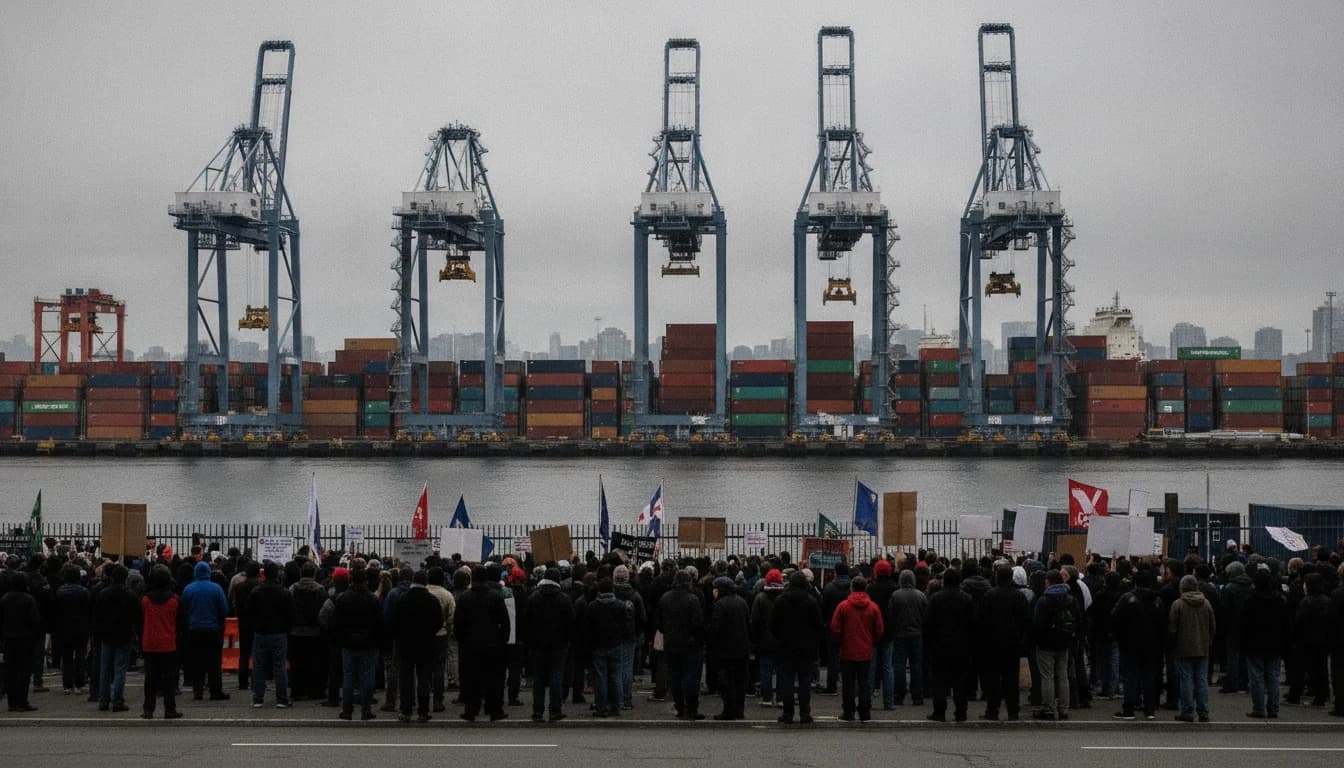
The Port of Vancouver’s Centerm terminal became the focal point of a broader labor-automation debate on September 23, 2026, when roughly 100 dockworker union delegates from Canada, the United States, Australia and New Zealand gathered outside DP World’s Centerm container terminal. The demonstration capped the International Dockworkers Anti-Automation Summit held in Vancouver, and it followed a week of organized events at the Maritime Labour Centre. Organizers framed the action as a pointed reminder that modernization can raise throughput without erasing jobs, while labor advocates warned that automation and AI must come with safeguards, fair transitions, and clear social dividends for workers. This moment matters for policymakers, shippers, and communities that rely on West Coast cargo flows, and it sits at the intersection of technology, bargaining power, and regional competitiveness. According to FreightWaves, about 100 dockworker union delegates from Canada, the United States, Australia and New Zealand rallied outside DP World's Centerm container terminal on September 23, 2026, launching an international anti-automation campaign. (freightwaves.com)
This report provides a data-driven snapshot of what happened, why it matters, and what comes next. It pulls from primary company disclosures, union communications, and government-commissioned research to present a balanced view of Centerm’s modernization, its employment implications, and the broader trends shaping Canada’s West Coast ports. The event itself sits within a larger modernization program that DP World characterizes as capacity-enhancing, while labor advocates emphasize the need for negotiated protections and a fair share of benefits. The following sections outline the sequence of events, the signposts that indicate the stakes for workers and employers, and the near-term outlook as port stakeholders navigate a period of rapid change.
What Happened
The protest’s origins and the summit backdrop
The September 23 rally did not occur in isolation. It followed the International Dockworkers Anti-Automation Summit, held at Vancouver’s Maritime Labour Centre in late September, where delegates from multiple countries aligned on principles related to technology deployment, worker protections, and bargaining processes. The gathering led to a joint statement and a marching route to DP World’s Centerm terminal, signaling that modernization could coexist with robust labor engagement if negotiated—rather than imposed—through contracts and social safeguards. The summit’s timing and messaging are summarized in contemporary reporting and participant accounts, which describe a coalition that sees automation as potentially positive when paired with retraining, wage protections, and transparent governance of dispatch and staffing. (freightwaves.com)
The numbers and the route of the protest
The rally on September 23 drew delegates from North America and beyond, demonstrating a transnational labor response to automation in a high-profile gateway terminal. As FreightWaves reported, the action featured a cross-border coalition and was framed as part of a broader campaign against “job-threatening automation and artificial intelligence at ports.” The event’s scale—roughly 100 delegates assembled outside Centerm—helped shine a light on the ongoing labor-management discussions around automation in DP World’s Vancouver operations. The report highlights the central tension: technology upgrades that lift capacity versus the potential for job displacement if staffing and scope of work aren’t renegotiated. (freightwaves.com)
Centerm modernization in context: what DP World says and what numbers show
DP World Canada emphasizes that Centerm’s modernization was a multi-year undertaking designed to lift capacity while upgrading safety and operational efficiency. In its October 1, 2026 release, the company points to an independent KPMG assessment that frames Centerm expansion as a model where investment in infrastructure, technology, and people yields both higher throughput and growth in waterfront employment. The release enumerates concrete results:
- Terminal capacity at Centerm rose by 65%, from 900,000 TEUs to 1.5 million TEUs; the footprint expanded by just 15%.
- Waterfront payroll hours increased by 59%, from 835,000 in 2019 to 1.328 million in 2025.
- Foreperson headcount grew by 75%.
- West Coast port workforce increased by 71%, from 5,100 to 8,700 workers between 2009 and 2025.
- About C$377 million has been invested in training and upskilling since 2010. The release frames these results as evidence that modernization and workforce growth can occur in tandem when technology upgrades are paired with ongoing training and collaboration with the workforce. The report it references is Technology, Training & Job Growth at Canada’s West Coast Ports: 2009 to 2025, produced for the BC Maritime Employers Association (BCMEA) by KPMG. For readers, the full KPMG findings are accessible via BCMEA’s impact pages. (dpworld.com)
In addition, DP World’s broader Canadian footprint and recent milestones surrounding Vancouver port infrastructure are documented on its corporate site. These materials corroborate Centerm’s role as a flagship modernization project and situate the Centerm upgrade within ongoing Western Canadian port improvements, including gate technology, rail capacity, and semi-automated equipment. Notably, DP World highlights Capex and technology investments that align with a capacity-driven modernization narrative. (dpworld.com)
What the protest signaled to workers, shippers, and policymakers
Labor advocates who participated in the Centerm action argued that automation must be negotiated with unions to ensure jobs, training, and fair work rules are protected. The protest’s framing—rooted in the International Dockworkers Anti-Automation Summit—emphasized that technology decisions should be conditioned by social outcomes, not just throughput metrics. The dialogue surrounding Centerm’s modernization thus reflects a broader conversation across Canada’s West Coast ports about balancing growth with equity for waterfront workers. Journalistic coverage of the event highlights the cross-border solidarity dimension and the fact that the summit’s conclusions fed into the subsequent protest at Centerm. (freightwaves.com)
A note on the broader port modernization landscape
The modernization discourse at Centerm sits alongside other West Coast port projects and analyses that quantify growth in cargo, staffing, and training tied to technology investments. BCMEA’s official materials emphasize that technology adoption has coincided with measurable gains in throughput and in the size and skill level of the waterfront workforce. The KPMG study cited by BCMEA tracks a 65% capacity increase at Centerm and a 71% workforce increase across West Coast ports from 2009 to 2025, underscoring a broader pattern in which modernization and employment expansion can move in parallel when guided by negotiated frameworks. (bcmea.com)
Why It Matters
The labor-management dynamic in modern ports
The Sept. 23 protest at Centerm is a concrete example of the frictions and opportunities created by port modernization. On one side, DP World and BCMEA stress that the Centerm upgrade delivered significant capacity gains and safety enhancements, and that a strong, skilled waterfront workforce accompanies these gains. The DP World release highlights a 65% capacity expansion and a 59% rise in payroll hours, with substantial investment in upskilling. On the other side, ILWU Canada locals and allied unions argue that automation, if not properly bargained, could erode secure waterfront jobs, redefine dispatch rules, and shift the balance of bargaining power. The protest’s framing—an international coalition opposing automation without social safeguards—reflects a broader concern that technology decisions at ports directly affect livelihoods, regional competitiveness, and the distribution of productivity gains. (dpworld.com)
The data behind the modernization argument
From a data perspective, Centerm’s modernization appears to align with a narrative of “capacity with workforce growth.” DP World’s release and the accompanying KPMG study show that capacity and payroll hours rose in tandem, and foreperson headcount increased markedly, suggesting that technology adoption did not simply automate away jobs but redefined roles and required new skills. The BCMEA data also point to large-scale gains in waterfront employment across Canada’s West Coast ports during the 2009–2025 window, with cargo growth accompanying workforce growth. The numbers paint a nuanced picture: automation can be a driver of both efficiency and employment growth when integrated with training, transition planning, and collective bargaining. (dpworld.com)
Implications for policy and bargaining
The Centerm episode occurs as the BCMEA, ILWU Canada and its local affiliates navigate complicated bargaining cycles and potential changes to staffing, dispatch, and automation governance. The Canada Industrial Relations Board (CIRB) has historically weighed in on union-management bargaining disputes related to automation and staffing at Vancouver-area terminals, including cases against DP World Canada and its foremen’s union. The 2024 CIRB decision, and subsequent negotiations, illustrate how labor-relations processes intersect with port modernization programs. Policymakers and industry observers watching Centerm should consider how negotiated frameworks—covering staffing rules, retraining commitments, and social dividends—can shape the pace and success of modernization while protecting workers’ interests. (canada.ca)
The broader regional and global context
Vancouver’s Centerm expansion, as a high-visibility modernization project, sits within a global trend of automated and semi-automated port technologies. Proponents argue that automation increases reliability, safety, and throughput, enabling ports to handle higher volumes and more diverse cargo in a competitive global market. Critics warn that unchecked automation without explicit worker protections can alter job security and working conditions. The Sept. 23 protest underscores that, in practice, the outcome depends on the quality of industrial relations during implementation, the clarity of governance around technology changes, and the availability of retraining opportunities for workers who are displaced or redefined by automation. The discussion at Centerm thus offers a case study for other ports evaluating similar modernization programs. (freightwaves.com)
What the data say about throughput, jobs, and technology
- Centerm’s capacity expanded by 65% to 1.5 million TEUs, according to DP World’s October 1, 2026 release (KPMG-based findings). This improvement is accompanied by a 15% footprint increase, indicating a relatively compact expansion that focused on efficiency gains rather than a broad land grab. (dpworld.com)
- Waterfront payroll hours at Centerm grew from 835,000 in 2019 to 1.328 million in 2025, a 59% increase, per the same DP World analysis. This indicates higher activity and potential job security for workers who gained more hours, even as automation changed the work mix. (dpworld.com)
- Foreperson headcount rose by 75%, signaling that supervisory and dispatch roles evolved rather than disappeared. This detail helps explain how automation can reshape work rather than simply reduce it. (dpworld.com)
- Across West Coast ports, the workforce grew 71% from 5,100 in 2009 to 8,700 in 2025, indicating a broader regional trend of job growth alongside modernization. These figures come from BCMEA’s synthesis of the KPMG report. (dpworld.com)
- Since 2010, BCMEA notes more than CAD 377 million invested in training and upskilling, underscoring the emphasis on workforce development as part of modernization. The emphasis on training is central to the argument that technology upgrades should be paired with human-capital investments. (dpworld.com)
These data points are critical for readers who want to understand the practical implications of the Centerm modernization and the protest’s resonance beyond one terminal. They illustrate how a major upgrade can be framed as both an efficiency driver and a catalyst for workforce development when paired with intentional training and negotiated protection for workers.
What’s Next
Watchpoints in bargaining, policy, and technology deployment
The Centerm episode will likely influence ongoing bargaining and policy discussions around port automation in British Columbia and across Canada. In 2024, Canada’s CIRB addressed disputes around automating operations at Centerm, underscoring the importance of good-faith bargaining and the role of third-party mediators in industrial relations. As the BCMEA and ILWU Canada navigate contract renewals and potential changes to manning, scheduling, and dispatch strategies, observers will be watching how technology decisions are negotiated, what safeguards are included, and how retraining commitments are structured. The broader context of West Coast port modernization—documented in official BCMEA communications and government reports—suggests that technology investments will continue to be a central aspect of port strategy, with labor relations playing a decisive role in shaping implementation timelines and outcomes. (canada.ca)
Near-term milestones and signals to watch
- The KPMG-based report on Technology, Training & Job Growth provides a data-driven baseline for evaluating future modernization efforts. While the Centerm expansion is complete, ongoing investments in training and workforce development will be essential to maintaining balance between throughput gains and job security. Readers should stay alert for BCMEA updates or new forecasts that quantify how much of the productivity gains translate into sustained, higher-wage, skilled roles for waterfront workers. The BCMEA materials and associated Port Authority briefings are likely to highlight these indicators as new cycles of modernization unfold. (dpworld.com)
- Regional port authorities and DP World Canada may publish updates on automation deployments, remote operations, and safety enhancements as part of ongoing modernization narratives. The DP World Vancouver expansion materials emphasize a technology-forward approach that includes automated gates and semi-automated equipment; subsequent communications may detail further enhancements or refinements based on performance data and safety reviews. Interested readers should track DP World’s Canadian news feed for updates on technology deployments and associated workforce initiatives. (dpworld.com)
- Industry analyses and trade publications will likely continue to compare Centerm’s capacity gains with its labor-relations framework, offering case studies for other ports considering similar modernization trajectories. Journal of Commerce coverage and other trade outlets have already begun examining how longshore unions respond to automation within stabilization periods and how capacity upgrades affect regional competitiveness. Such reporting will help readers gauge whether Centerm’s experience is a repeatable model or a localized outcome tied to BCMEA-ILWU negotiations. (joc.com)
What to watch for in official communications
- Next updates from BCMEA will likely emphasize the long-term workforce strategy tied to modernization, including retraining programs, new apprenticeship pathways, and safety standards associated with semi-automated equipment. The BCMEA’s public-facing materials already stress that growth in cargo and capital improvements must be paired with investments in people; future communications may provide more granular progress metrics and success stories across terminals beyond Centerm. (bcmaritime.com)
- DP World’s ongoing investments in Vancouver and other Canadian terminals could surface additional performance metrics, including throughput reliability, equipment utilization, and safety outcomes, as part of quarterly or annual reporting. Given DP World’s emphasis on capacity and workforce development, readers should expect further data-driven disclosures about productivity and training results to accompany modernization narratives. (dpworld.com)
Closing
The Port of Vancouver Centerm automation protest on September 23, 2026, underscored a pivotal truth about modern port modernization: throughput gains and job creation do not have to be mutually exclusive, but achieving that balance requires deliberate planning, transparent governance, and a strong emphasis on workforce development. The protest’s participants framed automation as a strategic choice that should be negotiated with unions, not imposed through unilateral actions. In the months since, corporate and industry assessments have pointed to meaningful capacity gains at Centerm alongside substantial investments in training and a growing waterfront workforce across British Columbia’s ports. For readers following the evolution of Canada’s trade and labor landscape, Centerm remains a bellwether: a laboratory for measuring how technology and people can advance together at one of the world’s busiest gateways.
Stay tuned for ongoing coverage as analysts, policymakers, and port stakeholders assess the real-world outcomes of automation investments—how they reshape jobs, how much of the productivity gains are shared with workers, and how these developments influence Canada’s competitiveness in global supply chains. To keep up with primary source updates, monitor DP World’s Canada newsroom, the BC Maritime Employers Association’s Impact pages, and trusted trade press coverage that tracks labor-management negotiations and port modernization milestones.