News
Cambie Street Bridge Seismic Upgrade Advances
Enhancements to the Cambie Street Bridge seismic upgrade progress with multi-phase funding secured; phase 2 construction is currently under way.
By Craig Burrows · August 18, 2026 · 12 min read
 By Craig Burrows · August 18, 2026 · 12 min read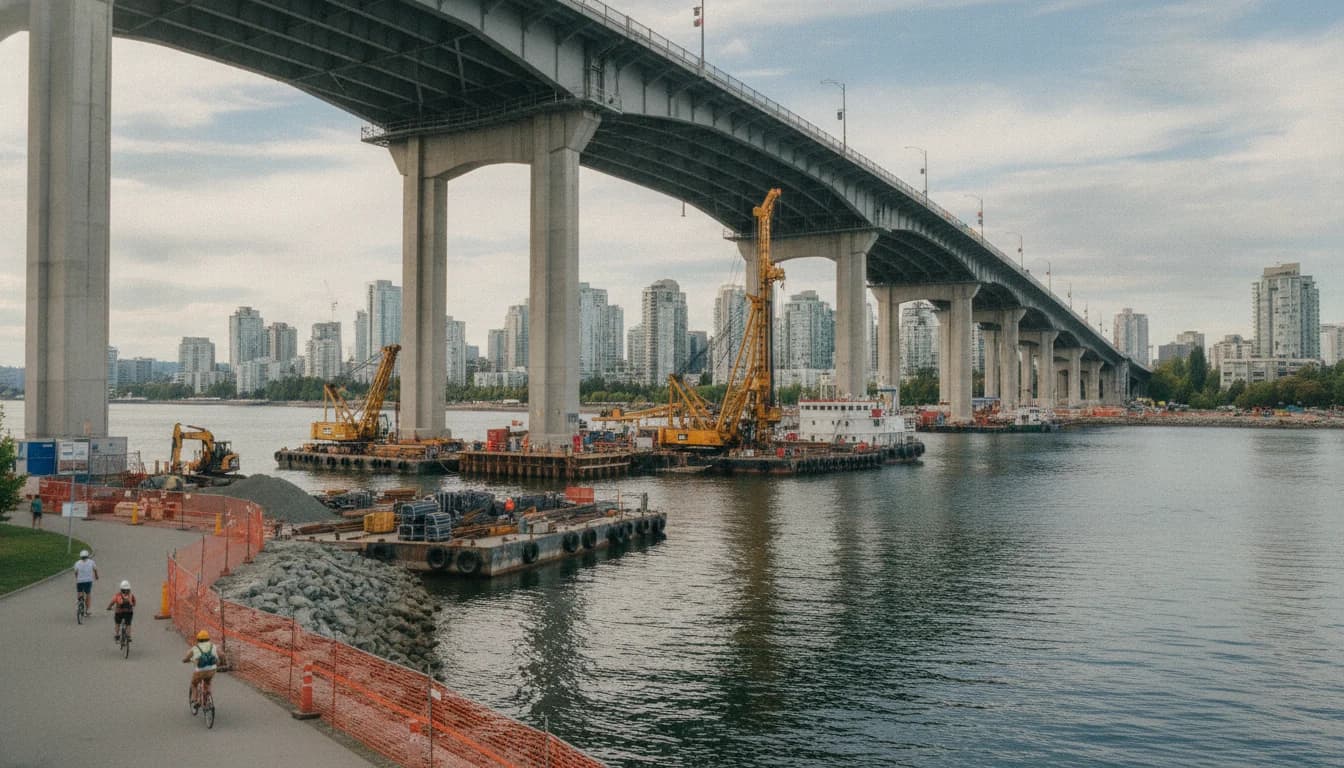
The Cambie Street Bridge seismic upgrade is moving forward as a multi-year, multi-part initiative designed to bolster Vancouver’s core transit artery against earthquake forces. On May 21, 2026, federal authorities, the City of Vancouver, and TransLink announced a combined investment exceeding $200 million to upgrade the bridge’s seismic resilience, a project that serves as a cornerstone for regional mobility and emergency response planning. The upgrade targets one of the city’s most critical transport links, a span that handles a substantial share of downtown Vancouver’s movement and supports essential services during emergencies. With the city’s Major Road Network designation and the bridge’s role in supporting multi-modal traffic, the Cambie Street Bridge seismic upgrade is not only a structural project but a public safety and economic continuity effort that aims to keep traffic moving and communities connected even after a major seismic event. The announcement highlighted that the Cambie Street Bridge carries more than 13 million vehicle crossings annually and functions as a major route for responders and freight, underscoring why seismic upgrades matter so much to Vancouver’s resilience. (canada.ca)
City officials have since detailed the phased approach to the upgrade, including work that will take place primarily below and around the bridge deck to minimize disruption to traffic. In early 2026, construction entered Phase 2, which is slated to run through spring 2028. This phase focuses on piers and foundation work beneath the bridge, complemented by associated shoreline improvements as part of Cooper’s Tidal Terrace Pilot Project. The city’s communications emphasize that pedestrians and cyclists will generally retain access, with detours planned only in limited locations along the False Creek seawall and Cooper’s Park area. The Cambie Street Bridge seismic upgrade is a long-term resilience effort that aligns with broader climate adaptation and safety objectives in Vancouver and the region. (vancouver.ca)
The government and city pages provide a concise funding framework and a concrete timeline for readers who are tracking the project’s financial and logistical progression. The federal government’s news release notes a combined investment over $200 million from the federal government, the City of Vancouver, and TransLink, designed to upgrade and rehabilitate the bridge through multiple program phases. The initiative is described as enhancing seismic resilience and ensuring continued access to critical infrastructure and emergency services. The release further identifies the bridge’s original opening year as 1985 and outlines the plan to implement seismic isolation bearings at all 65 bridge piers, among other structural improvements. In addition to the structural components, the project includes shoreline naturalization efforts along the north end of the bridge to test more climate-resilient seawall construction techniques. The quick facts section also highlights that the federal DMAF (Disaster Mitigation and Adaptation Fund) investment amounts to $84.4 million, with TransLink contributing $37 million and the City of Vancouver covering the remainder. These figures frame the project as a coordinated, multi-jurisdictional effort with a long horizon for completion. (canada.ca)
Section 1: What Happened
Phase 1 recap and context: groundwork laid in the early years
Phase 1 of the Cambie Bridge seismic upgrade was completed in 2022 and laid the structural groundwork for more substantial phase work to come. City records and council documents show Phase 1 included foundation upgrades, expansion joint repairs, concrete repairs, and related rehabilitation work, focusing on preparing the bridge to meet updated seismic standards and reduce long-term rehabilitation needs. This phase established the baseline for subsequent work, and it created the continuity needed to pursue a broader seismic upgrade that addresses both structural and lifecycle considerations. The completion of Phase 1 also set the stage for Public Project responsibilities and budgeting decisions that would drive the Phase 2 design-build step. The council’s notes emphasize that the Cambie Bridge seismic upgrade is a multi-phase program, with Phase 1 completed and Phase 2 continuing under a contractor-led construction program. The contractor for Phase 2 has been selected through the city’s established procurement process, confirming a structured, accountability-driven approach to delivery. (council.vancouver.ca)
Phase 1 accomplishments: what was achieved and why it mattered
In Phase 1, engineers and project teams focused on foundational upgrades that underpin any modern seismic upgrade. Those works encompassed foundation improvements that bolster the bridge’s capacity to withstand ground movements, as well as deck rehabilitation and joint work designed to improve performance during an earthquake. The intent was to reduce vulnerability and to set up a framework for more extensive work on piers, decks, and supporting infrastructure in later phases. While Phase 2 represents the more visible below-deck and piers-focused work, it is important to recognize that Phase 1’s successful completion created the conditions for a more robust seismic strategy over the longer term. The council’s Phase 2 contract award document notes that the Cambie Bridge’s seismic upgrade is a multi-phase program with Phase 1 finished earlier, illustrating the program’s staged approach to risk reduction and resilience. (council.vancouver.ca)
Phase 2 under way: scope, contractors, and milestones
Phase 2 kicked off in early 2026 and is planned to run through spring 2028, according to the City of Vancouver’s project updates. Work during Phase 2 is concentrated on localized seismic upgrades to bridge piers and foundations, with operations primarily below the deck to minimize traffic disruption. The city’s timeline confirms Phase 2 spans 2026 to 2028, emphasizing a focus on pier work, foundation upgrades, and associated structural improvements that will elevate the bridge’s resistance to seismic forces. In addition to the core structural work, the project includes the Cooper’s Tidal Terrace Pilot Project and shoreline improvements, supporting a climate-resilient approach to waterfront infrastructure. The City’s updates also indicate that the Cambie Street Bridge will remain open with minimal traffic impacts during Phase 2, a critical consideration for commuters and freight movements through downtown Vancouver. (vancouver.ca)
Phase 2 contract and cost: delivery, governance, and accountability
The City of Vancouver’s procurement documents provide a granular view of Phase 2’s delivery and financial framework. In October 2025, City staff received authorization to enter into a construction contract with Pomerleau Inc. for Phase 2, with an estimated total contract value of $36,554,751.25 (plus applicable taxes) over a two-year term. The contract is funded through the Multi-Year Capital Project Budget for the Cambie Bridge Seismic Upgrade and additional capital funding for the Cooper’s Tidal Terrace Pilot Project. The document outlines the procurement process, including prequalification, tendering, and the evaluation criteria, underscoring the project’s governance structure and the city’s commitment to value-for-money and transparent contracting practices. The procurement record also notes that the Phase 2 scope includes significant pier modifications at multiple locations and foundation upgrades in Cooper’s Park, reflecting the complexity and scale of the upgrade. (council.vancouver.ca)
Funding and partnership dynamics: who pays what and why
The federal government’s involvement is a central pillar of the Cambie Street Bridge seismic upgrade, reflecting a broader national emphasis on infrastructure resilience and disaster preparedness. The May 2026 Canada.ca release details a three-way funding partnership: the Disaster Mitigation and Adaptation Fund (DMAF) contributes $84.4 million, TransLink contributes $37 million, and the City of Vancouver covers the remaining project costs. The DMAF’s inclusion signals alignment with national resilience objectives and the recognition that seismic upgrades to major urban bridges deliver benefits far beyond individual municipalities. The release also highlights the project’s capability to reduce potential earthquake damage, shorten recovery timelines, and protect community infrastructure beneath the bridge. The amount and composition of funding illustrate how federal, provincial, and local stakeholders coordinate to advance critical infrastructure upgrades with a shared sense of urgency and accountability. (canada.ca)
The City of Vancouver’s communications mirror this funding narrative by detailing how money from multiple sources supports the program. The Phase 2 procurement documents explicitly reference funding sources, including the Multi-Year Capital Project Budget for the Cambie Bridge Seismic Upgrade and Emerging Climate Adaptation Priorities funding for the Cooper’s Tidal Terrace Pilot Project. While the exact split per source is subject to budget adjustments and approvals, the documents confirm a diversified funding mix designed to sustain a multi-phase upgrade over several years. This multi-source funding approach aligns with broader municipal finance strategies that often combine capital funds with climate adaptation allocations to deliver complex urban resilience projects. (council.vancouver.ca)
Section 2: Why It Matters
Structural resilience and public safety: a shield for critical infrastructure
At its core, the Cambie Street Bridge seismic upgrade embodies a preventive strategy to protect a vital arterial route in Vancouver’s transportation network. The federal government’s release emphasizes that the upgrade will enhance seismic resilience, enabling emergency response and essential services to operate more effectively after an earthquake. The plan to install seismic isolation bearings at all 65 bridge piers represents a sophisticated, technology-driven approach designed to decouple ground motion from the bridge structure, limiting damage and reducing downtime. This is a landmark step in upgrading aging infrastructure to modern standards, ensuring that the bridge remains an open and reliable link in the event of a regional seismic event. The project’s structural emphasis, complemented by targeted foundation work and pier modifications, signals a shift toward more resilient urban mobility infrastructure. The documentation highlights the goal of reducing earthquake damage and repair costs, a long-term economic rationale that accompanies the safety imperative. > “The Cambie Street Bridge is essential for downtown Vancouver to function, but it wasn’t built to withstand a major earthquake—we are investing to change that,” the federal spokesperson stated in the May 2026 release. (canada.ca)
Economic and transit network impacts: sustaining mobility and growth
Beyond safety, the Cambie Street Bridge seismic upgrade carries significant implications for Vancouver’s mobility ecosystem and the regional economy. The bridge’s high daily crossing volume underpins commerce, commutes, and visitor access. Maintaining lane parity and minimizing traffic impacts during Phase 2 are central to preserving transit reliability on a major urban spine. City communications emphasize that work will occur mostly below the deck, with detours limited to certain coastal and park areas, preserving through-traffic capacity and enabling emergency access when needed. The upgrade’s resourcing—$200+ million in combined funding—reflects a recognition that seismic resilience translates into fewer disruptions during and after disasters, preserving economic activity and reducing long-term maintenance costs. Local media coverage of the funding package underscores the broad public interest in keeping the bridge operational and resilient for decades to come. (vancouver.ca)
The collaboration among federal, provincial, and municipal authorities also has signaling effects for the broader market. Infrastructure funding programs like DMAF encourage other municipalities to pursue risk reduction projects with a climate and disaster-resilience lens. The federal and local partners’ approach to Cambie Street Bridge may influence how adjacent projects—such as other seismic upgrades in Metro Vancouver or across British Columbia—are funded and managed, potentially shaping procurement practices, risk management, and multi-stakeholder governance models. While specific market indicators extend beyond the Cambie Bridge project, the announcement places the Cambie upgrade within a growing context of resilience-driven infrastructure programs that connect engineering design choices with long-term community value. (canada.ca)
Environmental and community dimensions: waterfront shoreline and Indigenous engagement
The Cambie Street Bridge seismic upgrade goes beyond structural reinforcement. The Cooper’s Tidal Terrace Pilot Project and shoreline naturalization work reflect an integrated, climate-adaptive approach to waterfront infrastructure. Vancouver’s communications describe a shoreline design that is climate-resilient and nature-based, aiming to balance infrastructure needs with coastal protection, habitat restoration, and public access. This form of coastal adaptation aligns with broader municipal and provincial strategies to address sea level rise and coastal flooding, while providing opportunities for community benefit through landscape improvements and public spaces. The inclusion of a coastal restoration component is also consistent with reconciliation objectives, as project teams engage with Squamish, Musqueam, and Tsleil-Waututh representatives to ensure that Indigenous perspectives and traditional knowledge inform project decisions and land-use outcomes. The procurement and governance documents reflect these commitments, noting ongoing engagement with Indigenous leadership and the incorporation of sea-level considerations into shoreline design. These elements illustrate how the Cambie upgrade balances structural goals with environmental stewardship and community well-being. (vancouver.ca)
Public communication and transparency: a data-driven narrative for readers
From the outset, the Cambie Street Bridge seismic upgrade has been framed as a data-driven investment in resilience. Government and city materials emphasize performance metrics, anticipated risk reductions, and cost-benefit considerations that help stakeholders understand why the upgrade matters and how it will be delivered. The DMAF funding figure and the inclusion of 65 seismic isolation bearings provide tangible technical anchors for readers who seek concrete, measurable progress indicators. The public-facing communications also foreground timelines, milestones, and construction impacts, enabling residents, businesses, and commuters to anticipate phases of work and adjust travel plans accordingly. For a neutral, data-driven audience such as BC Times readers, these sources offer a clear, citable picture of what is happening, why it matters, and how progress will be tracked over time. (canada.ca)
Section 3: What's Next
Next milestones and project timeline: what to expect in the near term
Phase 2 remains the primary focus for the next two years, with construction activities concentrated on the bridge’s piers and foundational elements. City timelines indicate Phase 2 runs from January 2026 to spring 2028, with ongoing work under the deck and adjacent areas in Coopers Park and along the False Creek seawall. The Cooper’s Tidal Terrace Pilot Project represents a parallel track of work that intersects with the seismic upgrade, showcasing a holistic approach to resilience that includes both the bridge and its waterfront surroundings. The procurement documents provide additional context, noting that Phase 2 work was selected through a formal bidding process, with Pomerleau Inc. awarded the contract for construction services, reflecting the city’s disciplined project-management framework and emphasis on cost control and deliverability. The plan is to complete Phase 2 in a two-year window, after which additional rehabilitation and seismic upgrade activities will address remaining pier, foundation, and deck elements as part of Phase 3 and beyond. (vancouver.ca)
What to watch for: traffic, schedules, and community benefits
Readers should anticipate periodic traffic management around the Cambie Street Bridge area as piers and foundations are upgraded. City communications emphasize that the bridge will remain open throughout Phase 2, with some lane closures and detours in nearby sections as needed. This schedule is designed to preserve transit reliability while enabling essential structural work, a balance that is especially important in a dense urban core with heavy pedestrian and cyclist traffic. Additionally, the Cooper’s Tidal Terrace Pilot Project’s shoreline enhancements are expected to roll out in tandem with pier work, offering a visible demonstration of climate-adaptive design and new public spaces designed to improve coastal resilience and community access to the waterfront. As the project progresses, readers should stay attuned to official updates from the City of Vancouver and federal partners for changes to timelines, funding adjustments, and public notices related to detours and closures. (vancouver.ca)
The broader context: technology, markets, and infrastructure trends
The Cambie Street Bridge seismic upgrade sits at the intersection of engineering innovation and market dynamics in public infrastructure. The proposed installation of seismic isolation bearings across all 65 piers exemplifies an advanced, technology-first approach to earthquake resilience. This strategy aligns with current industry trends that favor modular seismic response systems, enhanced foundation techniques, and performance-based design to meet evolving seismic codes. The multi-year funding construct, with support from federal, provincial, and municipal sources, mirrors a broader market pattern in which government bodies pursue large-scale resilience investments through multi-phase programs that combine capital budgets with climate adaptation funds. The Cambie upgrade provides a case study in how a major urban bridge project can coordinate complex engineering requirements with public safety, economic resilience, environmental stewardship, and Indigenous engagement—an approach likely to inform similar projects across British Columbia and beyond. (canada.ca)
Conclusion In sum, the Cambie Street Bridge seismic upgrade represents a significant, multi-year commitment to urban resilience, safety, and mobility. With Phase 2 now underway through 2028 and a funding framework that blends DMAF support with city and TransLink contributions, Vancouver is advancing a high-profile infrastructure program designed to protect lives, sustain essential services, and sustain economic activity through future seismic events. Residents, commuters, and business owners should anticipate continued updates from the City of Vancouver and federal partners as work progresses, including potential detours around Cooper’s Park and the False Creek seawall, as well as periodic road- and water-front related adjustments tied to the Cooper’s Tidal Terrace pilot. The Cambie Bridge seismic upgrade thus stands as a defining example of how data-driven planning, transparent governance, and coordinated funding can converge to strengthen a city’s resilience while preserving everyday accessibility for the people who rely on it most. (canada.ca)